
Teacher’s Guide
(For use AFTER the “Stand Up! Stand Out!” anti-bullying assembly)
Specifically designed for practical application in the classroom

Production Licensing
Only by booking “Stand Up! Stand Out!” do you have the right to reproduce and distribute the materials from this Teacher’s Guide.
Copyright © 2025
Jason Tardy Productions, Inc
All rights reserved
For booking or more info email: JasonTardyPro@Gmail.com
“It was incredible! He’s truly an OUTSTANDING and INSPIRATIONAL performer! I highly recommend him!”
-Mary Finn Elementary School, MA
Who is Jason Tardy?
Jason Tardy has been performing professionally for over 30 years and it’s the only job he has ever had! He uses his strength (he juggles three 10lb bowling balls), intelligence (skipped a year of high school and was valedictorian), endurance (two-time 100 mile ultra-marathon finisher), and skill (he has no social life so he practices a lot) to create crazy high-energy comedy and juggling shows like you’ve never seen before…unless you’ve seen him before.
His career started in 1994 as a young teenager in the small town of Buckfield, Maine where he met local comedy juggler Michael Miclon and become his apprentice. The apprenticeship opened many doors including the opportunity to train at the World-renowned Celebration Barn Theater with Mime Master Tony Montanaro, as well as jugglers Michael Menes and Peter Davison. Later he trained and performed with the world’s most highly awarded juggling troupe, “blink”.
Jason faced bullying during middle and high school because some kids thought that he was weird for wanting to be a juggler. Fortunately, he stood up to those bullies, achieved his goal, and starting performing full-time right out of high school.
His hard work and experience in the performing arts has brought him all over the US and abroad. Some highlights include Disney Cruise Ships, the Atlantis Resort in the Bahamas, the television programs CBS Sunday Morning and Inside Edition, and even The White House in Washington DC three times!
Current School Presentations
-All of Jason’s educational presentations can be adapted to fit grades K through 12-
“Stand Up! Stand Out!” is an exciting juggling and stunt show with a powerful anti-bullying message. This show empowers students and gives them the tools they need to make a difference in their school and by becoming an Upstander.
“Tunnel Vision” is a complete character education performance that will grab students’ attention with Jason’s amazing performance skills, while showing them the importance of setting goals, making healthy choices, and the importance of education. This show is perfect for Career Day, Red Ribbon Week, Wellness Day, SEL Day and more.
“Dropping the Ball” is a hands-on workshop where kids learn the basics of juggling through making mistakes. Jason teaches the importance of letting go of the idea of being perfect by literally dropping the ball and focusing on learning first.
Jason can also create customized shows to fit your school’s goals as well as fundraiser shows and more.
What is this guide for?
The goal of my “Stand Up! Stand Out!” assembly is to give students the tools necessary to deal with bullying situations, but I cannot do it alone. That is where you come in! My hope is that you will use this guide to reinforce the concepts and techniques I talked about in my performance to make a long lasting impact and change the culture of bullying in your school.
The activities in this guide should be used after my performance. I have provided vocabulary, activities, posters, and discussion questions. Use only the material you feel is appropriate for your grade level.
As you may have noticed I like to approach learning in a fun and playful way so feel free to adjust as needed and have fun!
Let me know if you have any questions or suggestions along the way. Thanks!
Email: JasonTardyPro@Gmail.com
Concept #1: Rude, Mean, or Bullying?
DEFINITIONS
Feel free to go over these definitions and examples with students so everyone is “speaking the same language.”
RUDE
adjective
When someone unintentionally hurts your feelings once. Usually it spontaneous and is based on carelessness, poor manners, or selfishness.
Examples:
Social errors like burping in your face, cutting in line, bragging, or throwing something that accidentally hits you.
MEAN
adjective
When someone intentionally hurts your feelings once (or possibly twice).
Usually it is motivated by angry feelings or trying to make themselves seem better than you.
Examples:
Saying something like, “You are so fat/ugly/stupid” or “I hate you!”
Note: The biggest difference between being rude and mean is the intent behind the actions.
BULLYING
verb
When someone intentionally hurts your feelings and keeps doing it over and over again even when they see you are upset. It involves an imbalance of power where the bully has more power than you (or thinks they do) and uses that power to be hurtful.
Examples:
Someone intentionally trying to hurt your feelings over and over again by pushing you around, making fun of you, gossiping about you, threatening, or trying to embarrass you.
Note: Cyberbullying is the same as bullying but it happens online.
GOSSIP
noun
conversation or reports about other people’s private lives that might be unkind, disapproving, or not true.
Concept #1: Rude, Mean, or Bullying?
Discussion questions:
These questions can be used as a writing exercise or a classroom discussion
- Name two things that makes bullying different from being rude or mean.
- How can the same incident (for example: someone hitting you with a ball) be perceived as being rude, mean, or bullying?
- How can gossiping about someone be considered bullying?
Activity: Posters
Break up into groups and create your own poster explaining the difference between being Rude, Mean, and Bullying. Put them up around the school to help educate other classmates.
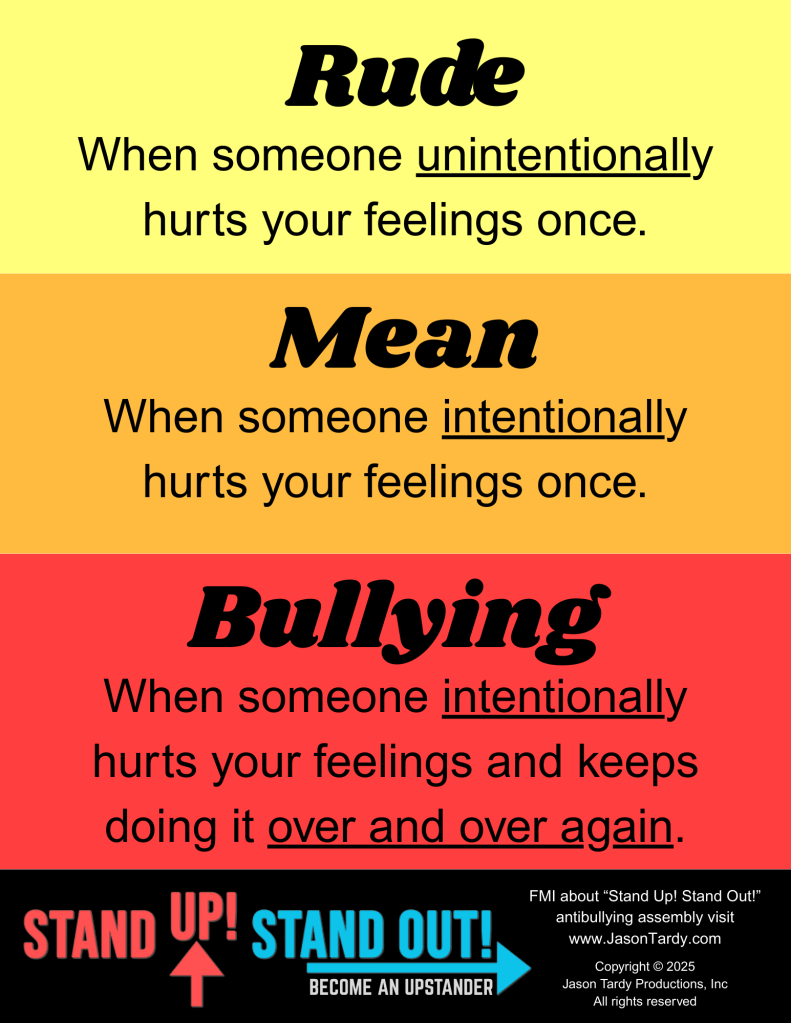
Feel free to print these out and put them up around your school
Concept #2: Types Bystanders and the roles they play
DEFINTIONS
Feel free to go over these definitions and examples with students so everyone is “speaking the same language.”
BYSTANDER
noun
(In relation to bullying) Someone who sees or knows about someone else who is being bullied.
Note: Bystanders can be friends, students, peers, teachers, school staff, and even parents. They can be either part of the bullying problem or an important part of the solution to stop bullying depending on what type of Bystander they are.
Types of Bystanders:
ASSISTANT Someone who helps the bully by joining in on the bullying behavior.
REINFORCER Someone who laughs at the bully’s “jokes”, cheers them on, or encourages the bullying behavior.
OUTSIDER Someone who does not get involved, and stays out of it. Unfortunately by doing “nothing” the bully sees this as silent approval of their actions.
UPSTANDER Someone who takes a positive action to help stop the bullying behavior.
Discussion Questions
These questions can be used as a writing exercise or a classroom discussion
- How does it make you feel when you see someone being mean or bullying someone else?
- How can doing “nothing” make bullying worse?
- Why or why not do you think it is OK to laugh at a joke that hurts someone’s feelings?
Stand Up! Stand Out! Concepts 1 & 2 Crossword Puzzle
This crossword can be given with or without the word list below
Crossword word list
Rude
Bully
Outsider
Upstander
Reinforcer
Assistant
Mean
Bystander

Concept #3: R.E.A.C.T. Responsibly
5 ways to REACT to a bullying situation and become an Upstander
- Report the behavior to an adult. Getting help is not tattling because bullying is serious and the person being bullied needs help. Example: Tell a teacher, parent, counselor, or school resource officer.
- Explain in a calm, clear way that what they are doing is not OK. If you yell or get aggressive at all it will not help and it may encourage more bullying. Example: “Hey, that’s not cool. You should stop.”
- Ask them why they are doing it. That shows them you are not OK with what they are doing. This option is not as confrontational as telling them to stop directly. Example: “Why are you making fun of them?”
- Change the subject. By distracting the bully in some way it can get the focus off the person being bullied which might be enough to diffuse the situation. This can work great especially if the bully is a friend of yours. Example: “Hey check out this video I just watched” or “Look outside! A UFO!”
- Take the person being bullied to a safe place. Walk over to the person being bullied and walk them to a safe location. You do not have to interact with the bully in any way but you are showing them you are not OK with their actions. Example: Bring the person being bullied over to a group of friends or near an adult where the power imbalance will not be as great and the bully does not feel comfortable bullying.
Discussion Questions
These questions can be used as a writing exercise or a classroom discussion
These questions can be used as a writing exercise or a classroom discussion
- Why do you think yelling at a bullying makes bullying worse?
- Name two things you could do to help someone who is being bullied.
- Why do you think kids helping in a bullying situation is important? Why not leave it to the adults?
Activity: Paper Chains
Cut paper into narrow strips of equal size. Have students write something they will try to do next time they see someone being bullied on the strips. Fold the strips into links of a chain with tape or staples. String the chain along a wall in the school to show that together they can combat bullying.
Break up into groups and create your own poster illustrating how to help someone who is being bullied. Put them up around the school to help educate other classmates.
Activity: Posters
Break up into groups and create your own poster illustrating how to help someone who is being bullied. Put them up around the school to help educate other classmates.

Feel free to print these out and put them up around your school
Concept #4: R.E.S.E.T. when being bullied
5 ways to RESET when YOU are being bullied
- Report the behavior to an adult. Getting help is not tattling because bullying is serious and you need help. Example: Tell a teacher, a parent, counselor, or school resource officer.
- Explain in a calm, clear way that what they are doing is not OK. If you yell or get aggressive at all it will not help and it may encourage more bullying. Example: “You need to stop.”
- Stay Away from the bully or stay with a group of friends. Staying away from the bully even for a few days may break the cycle of bullying. Example: If you are bullied usually during lunch, find a way to have lunch in a different location.
- Exercise Control of your emotions by staying calm.The bully wants you to get mad and upset so by staying calm it takes away their power over you and makes it “not fun” for them. Never get aggressive or violent because that usually makes the bullying more severe. Example: Ignore a bully calling you a terrible name or even use humor to deescalate the situation by agreeing with them.
- Talk to someone about how it makes you feel. Bottling up uncomfortable feelings can lead to depression, anxiety, decline in grades, and even self-harm. Example: Tell a trusted friend, counselor, teacher, parent, or therapist about how it makes you feel. If you are in crisis call or text 988 lifeline to talk with someone about it. You are not alone.
Discussion Questions
These questions can be used as a writing exercise or a classroom discussion
- Why do you think punching or being aggressive with a bully leads to more severe bullying?
- What are two things you could do if someone is bullying you?
- What are some ways of keeping yourself calm when faced with bullying?
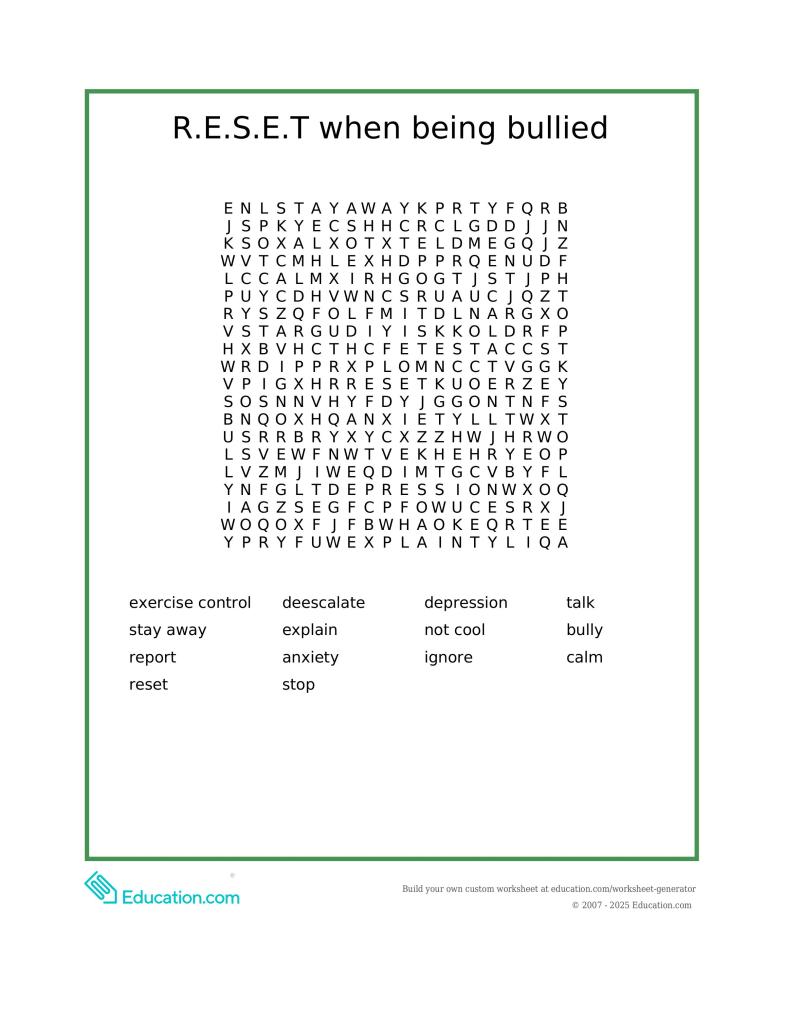
Activity: R.E.S.E.T. Word Search
Activity: Posters
Break up into groups and create your own poster explaining what to do if you are being bullied. Put them up around the school to help educate other classmates.
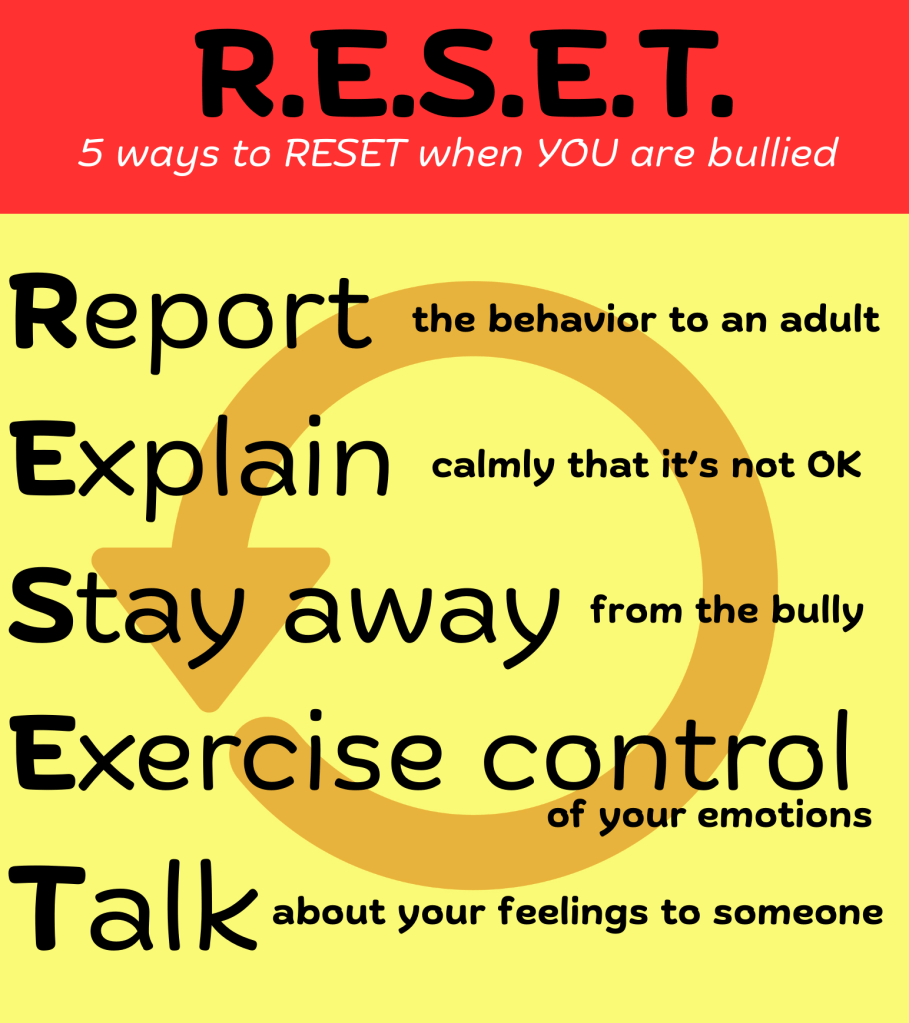
Feel free to print these out and put them up around your school
Thank You!
I hope you found this Teacher’s Guide helpful in reinforcing the concepts I laid out in my assembly. Now the kids should have a better idea of:
-The differences between being Rude, Mean, or Bullying
-How to R.E.A.C.T. when they see someone being bullied
-And how to R.E.S.E.T. when being bullied themselves
I would love to hear your thoughts and ideas of how I can improve this guide so feel free to reach out to me with ideas or questions. Email: JasonTardyPro@Gmail.com
Additional Resources:
Official US governmental website on bullying
StopBullying.gov YouTube Channel
988 Suicide & Crisis Lifeline
Free, confidential, call, text, chat
Elementary activities from the National Bullying Prevention Center
Middle/High School activities form the National Bullying Prevention Center
Copyright © 2025
Jason Tardy Productions, Inc
All rights reserved
 Jason Tardy Productions